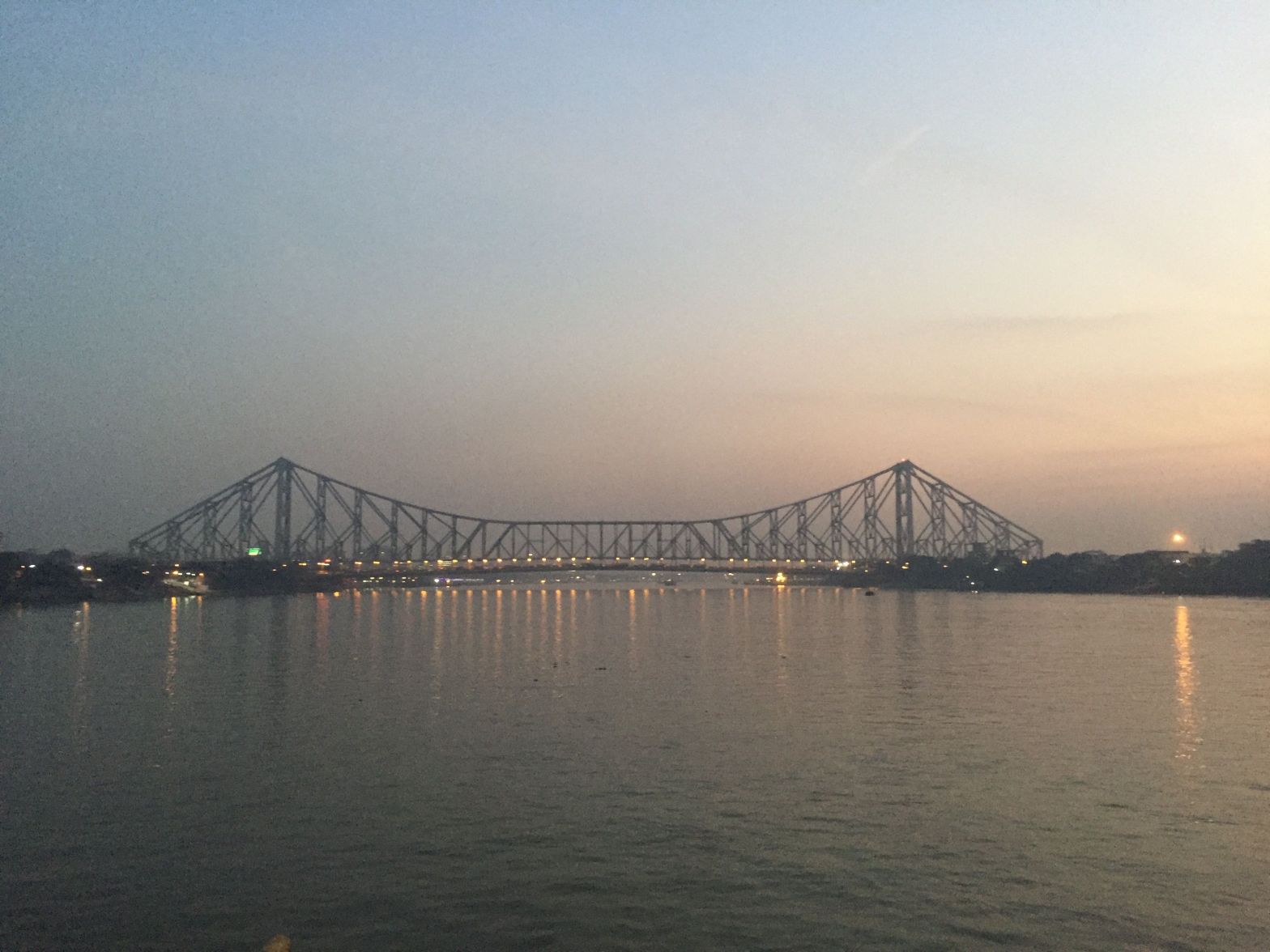
Day slips to night as we motor up the Hooghly, a distributary of the Ganges, the holiest of Indian rivers. Orange sky turns to pink. Teenagers sit onshore bathing in the crepuscular glow. The golden orb of the sun flirts with bedtime. Sitar chords waft above the water’s surface.
We pass grand Babu houses built by Bengali petite bourgeois who colluded with the British Raj, their structures sagging but still elegant. Past the Howrah flower market where thousands of marigold and zinnia garlands are sold in deference to the Hindu bureaucracy of gods. And Hindu temple after temple proclaiming the eminence of Kali, the patron god of Calcutta.
What is remarkable is not that this world exists so close to traffic jams, the incessant honking, the congestion, the untidy pulse of Calcutta. We’ve been schmeared for days with what we’ve found Calcutta to be: a cacophony car horns, pushing, crowded subway cars, sidewalks filled with department store merchandise: Antacids, chai, cologne, brushes, combs, SIM cards, cellphones, umbrellas, belts, shirts, sandals, underwear, shoelaces, keys, dhosa, pants, shorts, shoes, rings, and oranges.
No, what is remarkable is how easily this bucolic scene eases the nerves, lowers the blood pressure. Like a film negative, this is the opposite of the city it parallels. Light and dark, dark and light. Noise and silence in reverse.
I knew Calcutta would be a challenge. The home of The Black Hole of Calcutta and Mother Theresa’s orphanages. All my boundaries would be pushed: Intimate poverty, bodies in the subway, gastro-intestinal distress. Calcutta proved to be a challenging city to love.
But this final boat trip on the Houghly reminds me that in a matter of hours I will be transported from here, flying at 40,000 feet in a metal tube headed for home. The daily trials of a city I have come to find both intolerable and endearing will be over. The claustrophobia, the closeness, the overwhelming lack of control will be gone. But also, the sideways nods. the exuberant helpfulness, the selfies with strangers. I will be in a land of drinkable tap water and edible salads. But nobody will want their picture taken with me.
Stop the shooting I scream in my head. Whoever is playing the sitar should not stop. Freeze the sunset. Preserve this moment. I don’t want it to end. This is the Calcutta I want to remember.
But nobody listens. The boat turns around and I sit on the bow of the boat facing downriver, reading poetry, wrapped in the comfort of language, music, and the Ganga, the mother of all rivers.
We float under the Howrah bridge, decked in garlands of lights. Above us city buses, trucks, pedestrians all battle on their commute home.
Could we just keep going? Another hundred miles and we’d be at the mouth of the Ganga. We could disappear into the bluish black expanse of the Indian Ocean.
 Mark Lammers