As a kid I was proud of my Swedish heritage. There was always a Swedish Christmas Eve at my Great-Aunt Jane’s house where we’d eat rice pudding and fruit soup and drink glög. There were expressions my Dad learned from his grandmother— så går det (so it goes) and god dag, god dag (good day, good day) My mother sometimes called me pojke for boy, and my sister flicka for girl. In the Wonder-Bread-sameness of suburban Minnesota, being Swedish made me feel more interesting. A connection with a distant place made me feel exotic.
I always knew that I probably had family in Sweden given that both my parents were part Swedish although I had never been there to meet any of them. But four years ago I had my first contact— an email from a distant cousin, Kajsa, a descendent of my great-grandmother’s brother. This year, when I told her that the time had finally come for me to visit Sweden and to meet family there, she invited me to celebrate Midsommar, the Swedish Summer Solstice celebration, with she and her family at her cabin the Stockholm Archipelago. My Dad and sister were able to come with me. But, I wondered, would Sweden and my family there, make me as happy as anticipating had it for all those years.
In the Stockholm Harbor we board a boat called Viberö, a small foot-ferry festooned with birch branches, early on Midsommar morning. The sun is bright, the mood exuberant, festive, almost triumphant. Surviving a northern winter will do this to people. Women wearing sundresses and garlands of flowers in their hair. Bags clank with the wine bottles inside and people schlep their heavy coolers filled with beer onboard. As the boat pulls away from the dock, the blue and yellow cross of the Swedish flag unfurls in the bright sunshine. I watch out the window as the seascape unfolds: Islands of gray-granite rock, shorn smooth by glaciers, Pine and Birch woods, cotton-candy clouds against a cerulean sky. I immediately feel at home. This landscape is a doppelgänger for the lake country of northern Minnesota and Wisconsin, where I’ve spent a lot of time in earlier years, and of Puget Sound in the Pacific Northwest, near where I live now.
As the Viberö pulls up to the island of Fiversätraö, I see Kajsa and Ola standing and waiting for us on the tiny dock. I wonder how my great-grandmother Hilma must have felt when her ship pulled up to Ellis Island in 1896 when she was only 18. Was she terrified or excited?
Kajsa and Ola welcome us to Fiversätraö, and to Sweden with open arms.
Ola pulls up a wheelbarrow and says, “This is as close as we come to a car on the island.” We throw our bags into it.
“And this is our main street,” Kajsa says, as she points to dirt trail leading up the island.
The birch trees quake in the wind and we head up the long trail to the cottage, which sits on a high point of land, perched on a granite hill overlooking the water.
When Kajsa’s mother died a few years ago she found a box in the basement filled with photos and letters, some of them from Great-Aunt Jane who had written to her grandfather in the 60s. Curious, she began researching, creating a family tree on Ancestry, and eventually she found me.
“My grandparents built this place in the 60s,” she says.
I look around at the moss-covered rock, the gigantic sky, the distant sea.
“I’ve been coming to this island since I was a child.”
Lunch is ready soon after we get settled in. “We always eat the same food at Midsommar,” Kajsa says. On the table she’s arranged several kinds of Sill (pickled herring), knackbröd (rye crackers), gravlax (smoked salmon), boiled new potatoes, scalloped potatoes called Jansen’s Temptation, beer and snaps. We each take a plate and pile our plates with food.
“We have to teach you the snaps songs,” Kajsa says. “We only sing these songs once a year at Midsommar.” The first song, Helan Går (The Whole One Goes Down), has a catchy tune (here is a clip of ABBA singing the song) Once you learn it you can’t get it out of your head. Helan går, Sjung hopp faderallan lallan lej, Helan går, Sjung hopp faderallan lej. Our Swedish is garbled but I hardly think it matters as we empty tiny shot glasses of fiery snaps.

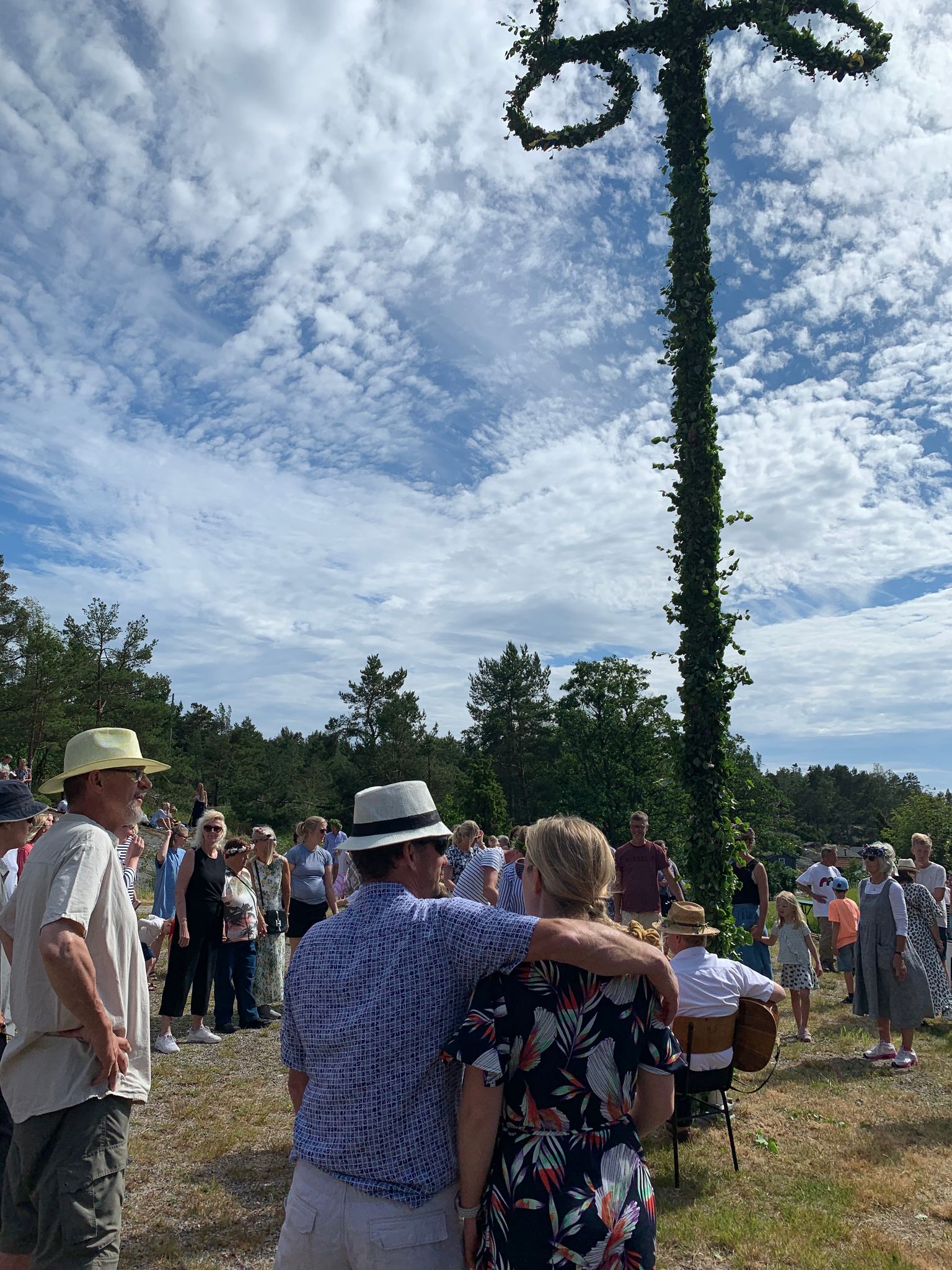
After lunch we walk back down to the ferry dock, where the afternoon festivities are building under the midsommarstång, the maypole that is really a cross festooned with birch branches and flowers.
“Do you want to dance?” Kajsa asks, “we must dance, it’s your first Midsommar,” and pulls is into a circle of dancers surrounding the maypole and holding hands. We dance the traditional Små grodorna (Little Frogs) dance: Små grodorna, små grodorna är lustiga att se. Ej öron, ej öron, and we all hop like frogs and laugh. These are children’s dances, Kajsa explains, but adults partake as well.
Midsommar developed in Sweden as a celebration of St. John the Baptist’s Day. Apparently, there is no evidence of it being a pagan celebration, however I can’t help but feel that we owe something to pre-Christian nature worshipers here. The flowers in women’s hair, the Maypole decorated with birch branches and the silliness tells me that Midsommar is not a pious religious holiday, but one that revolves around the changing season, around family, around friends and around having fun. Although it is celebrated throughout Scandinavia, it’s really a bigger deal in Sweden than anywhere else, or so I’ve been told.
“There is going to be a tug of war after this” Kajsa says later, as we sit and watch the dancer. “The people from the north side of the island compete with those on the south. We need all the help we can get.”
We look at each other. We were up early for the boat and are sleepy.
“Or would you rather go back and have some strawberry cake?”
We all nod at the cake idea and head back to the cabin.
We have naps, cake, a sauna, more food, a little more snaps, more songs, and then it’s time to head back down to the evening festivities.
There are several games going on—one involves how far can you spit a piece of hard candy and the other how many beer bottles can you knock over by spitting a yellow pea through a pipe. I got to be not bad at the yellow pea thing. At the dock they have set up a makeshift disco under a tent. Garlands of hanging lights make the dancefloor glow. We pull our stiff, middle-aged hips onto the dance floor and join the little kids dancing to ABBA’s Gimme! Gimme! Gimme! Midsommar seems to be a state of mind as much as it is a holiday. It’s about turning the world upside down to dump all the seriousness out of it.
As the sea-sky turns canary yellow, I can’t help but feel the irony. I’ve come halfway around the world to a place I didn’t know, only to find that it feels like home. And I’ve meet relatives I never knew. who I feel like I’ve known all my life.
I think of the lines to my favorite Talking Heads song, “This Must Be the Place”— Home, is where I want to be, But I guess I’m already there, I guess this must be the place. There are several places I consider home—The Pacific Northwest and the Northwoods of Minnesota and Wisconsin. And now will I add this island in the Stockholm Archipelago. And I think of the loving family I already have and how it’s grown a little bigger now.
The next day Kajsa and Ola see us off on the boat back to Stockholm. I wonder how my great-grandmother felt being uprooted from her home and family to find a new home halfway across the world. As the boat pulls away I feel a pang of longing for this home and a family I’ve just come to know. But as I sit and watch the crouching granite islands and birch forests in retreat, I relax, and I begin to plot my return.
 Mark Lammers